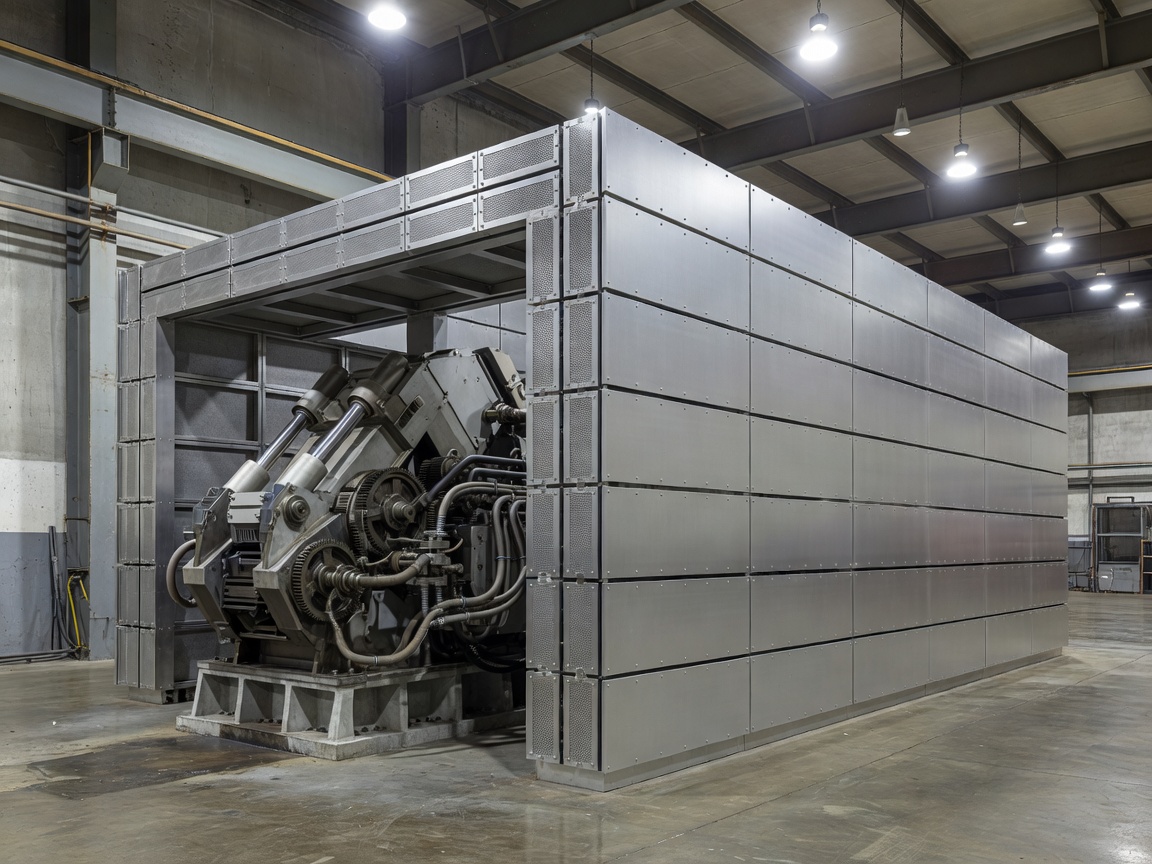
Barriers and enclosures address a simple acoustic idea: interrupt or contain the path between a source and the people affected by it. The details are less simple. Machinery needs air, operators need access, maintenance needs room and processes may need to be watched continuously. A barrier that looks substantial can still perform modestly if sound travels around it, underneath it or through an open service route.
Choose the boundary that matches the problem
An acoustic screen is usually a local intervention. It can interrupt line of sight between a source and a nearby operator, route or neighbouring bay. Screens are useful where complete closure would be unsafe or impractical. Their effectiveness depends on height, width, position and the amount of sound that can diffract around the edges.
A partial enclosure surrounds some sides or the roofline of a source while leaving operating or service openings. It offers more containment than a simple screen, but those openings become important acoustic pathways. A full enclosure creates the strongest boundary in principle, yet it also creates the greatest demands for ventilation, access, observation and heat management.
Source containment is often efficient
Containment places treatment close to the source, reducing the amount of sound released into the wider room. This can be helpful when one machine dominates a local problem. The enclosure may combine a dense outer construction, internal absorptive lining and carefully designed doors or viewing panels. Each layer has a role: mass resists transmission, absorption reduces internal build-up, and sealed interfaces limit leakage.
Do not assume that thicker is automatically better. A poorly closed joint or permanently open access panel can undermine a carefully selected construction. The route around the enclosure matters as much as the material within it.
Access and ventilation are not details
Maintenance access should be mapped before a boundary is drawn. Consider lifting points, filters, belts, lubrication, inspection windows, emergency release and the movement of replacement parts. Doors should be practical enough that people do not leave them open because they are awkward. If a machine needs frequent access, a removable or modular arrangement may be more useful than a fixed box.
Ventilation openings need acoustic attention. Air routes can become sound routes, so use bends, lined sections or suitable attenuating arrangements where appropriate. At the same time, ensure the machine does not overheat or lose required airflow. Acoustic work must sit alongside the equipment manufacturer’s operating requirements and a competent safety review.
Material selection
Select materials for the environment: temperature, oil, dust, moisture, impact, cleaning and fire considerations all matter. Internal absorptive finishes should be protected where fibres, edges or exposed faces could be damaged. External surfaces may need to withstand vehicles, tools or wash-down. The quietest material on paper is not necessarily the most durable choice for a busy production floor.
Advantages and limitations
Barriers are comparatively flexible and can improve a local line-of-sight path with limited construction. Their limitation is that sound can travel around them and they may not address reverberation across the room. Enclosures provide stronger source control and can make a major difference around a dominant machine. Their limitations include cost, access, heat, ventilation and the risk of making observation or intervention harder.
Partial enclosures sit between the two. They can be a sensible compromise where the process has open loading or unloading. The compromise should be explicit: identify the remaining openings and decide whether the resulting control is enough for the people and areas concerned.
Plan, inspect, adjust
Use a marked layout to show doors, service routes, airflow, sightlines and maintenance positions. After installation, inspect seals, hinges, panels and ventilation paths as part of normal maintenance. Production changes may create a new opening or move an operator closer to the source. Containment is not a fit-and-forget object; it is part of the facility’s operating system.