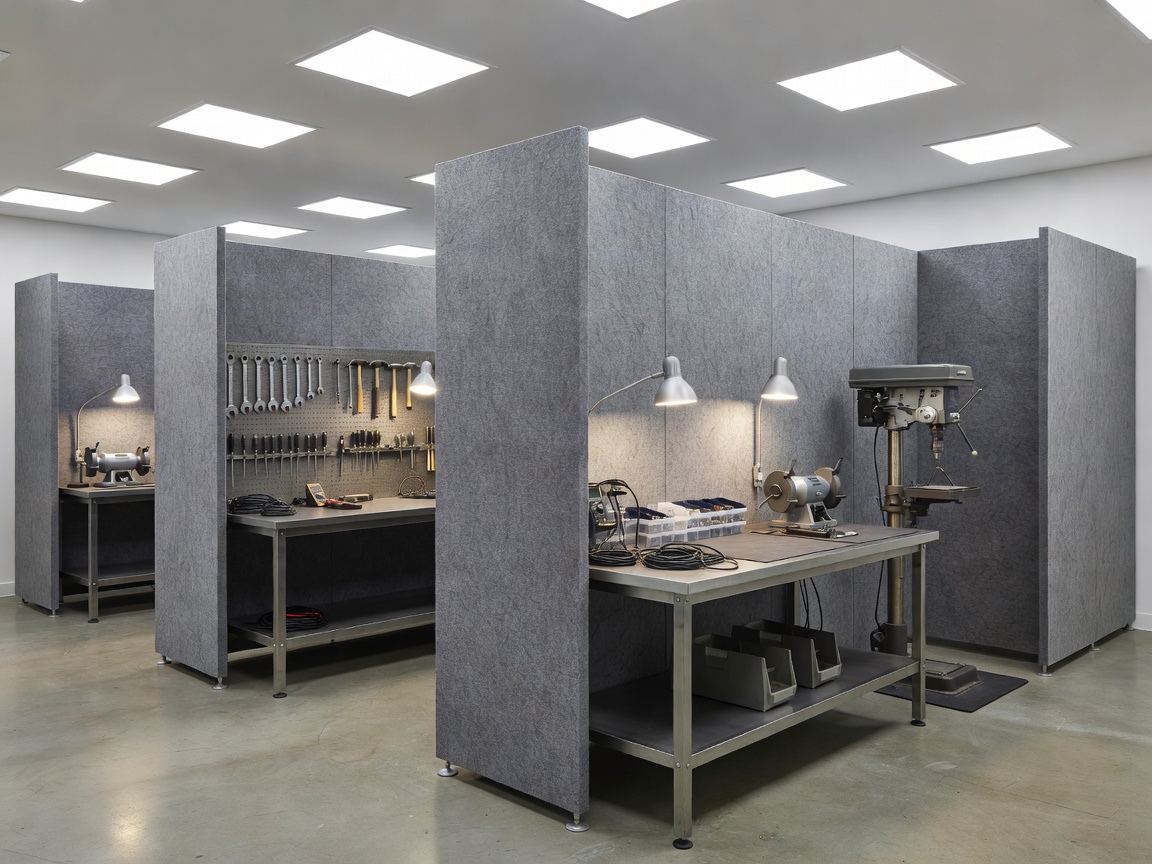
Workshops are acoustically lively places. Power tools, compressed air, impact work, extraction, metal handling and vehicle movements may all happen within a short distance of one another. Unlike a large production hall, a workshop often has changing tasks and limited room for permanent interventions. Noise control therefore needs to be practical, repairable and considerate of the person who has to move a bench tomorrow morning.
Identify the workshop’s loud moments
Begin by observing when the problem is most noticeable. A grinder used briefly may be less disruptive overall than a compressor that cycles throughout the day. A saw can create a direct, high-energy path to a nearby workstation, while a hard ceiling keeps ordinary conversation bouncing around long after the tool stops. Note duration, position, direction and who is exposed.
Speak with operators rather than relying on a plan alone. They can identify awkward tool locations, doors that transmit sound and work that has migrated because one bay is uncomfortable. This information helps avoid a tidy but unhelpful intervention.
Work bays and equipment placement
Where possible, place high-noise tasks away from communication-heavy work, entrances and shared routes. Orient equipment so its strongest opening or exhaust does not face an operator or neighbouring bay. Keep noisy mobile equipment from becoming a permanent feature beside a desk simply because that is where a socket happens to be.
Separate impact tasks from precision or inspection tasks. Even modest distance can help, especially when combined with a screen or absorptive surface. Keep routes clear and preserve the access needed to move stock, remove guards and service machinery.
Partitions and absorption
Partitions can interrupt a direct sound path between bays. They work best when they are tall enough and positioned close enough to matter, while still preserving sightlines and safe movement. Gaps at the sides and top reduce their effect, but some openness may be essential for ventilation, supervision or lifting.
Absorptive panels on selected walls or ceilings reduce reflections. They are most useful in hard, compact workshops where sound repeatedly returns from parallel surfaces. Choose robust, cleanable materials and protect them from sparks, oil, impact and wash-down. A soft product in the wrong bay is an expensive sponge with a short career.
Operator areas deserve attention
Control desks, inspection points and handover areas often sit just outside the obvious noisy zone. Treating these locations can improve communication even when the source cannot be substantially changed. A local screen, a change in orientation or a more absorptive wall behind the operator may be worthwhile.
Do not place treatment where it creates a new hazard. Keep emergency equipment, exits, visibility and access routes clear. Acoustic improvement should support the job, not ask people to work around it.
Follow the pathways
Noise can travel through open doors, roof voids, ductwork and lightweight partitions. If a quiet room is beside a workshop, inspect the shared wall, door seals and service penetrations. If sound reaches an office through a corridor, treating the workshop alone may not address the route. A quick plan with arrows showing likely paths can clarify where to spend effort.
A sensible improvement sequence
First, maintain and isolate equipment where feasible. Second, adjust layout and work scheduling. Third, use barriers or partitions for direct paths. Fourth, add absorption to reduce reflected sound. This sequence is not a rigid hierarchy, but it keeps the solution from becoming a wall of panels around a machine that still vibrates, leaks or points straight at the operator.
Review the workshop after changes. Ask whether communication, visibility, access and cleaning remain straightforward. Noise control is successful when people can use the space naturally, not when the room merely looks acoustically considered.